
You might have observed that some concrete structures develop cracks over time. Did you know that one of the most common reasons behind these cracks is the improper curing of cement concrete during casting or application?
lets understand the science behind this first!
When water is added to cement, a series of exothermic chemical reactions known as hydration begins immediately. This process is responsible for the cement setting (stiffening) and hardening (gaining strength) as it transforms the powder into a dense, rock-like material.
| Phase | Timeframe | Reaction Rate & Key Chemical Event | Primary Physical Effect on Concrete |
| Initial Mixing Reaction | Immediate | Rapid reaction; Ions dissolve. | Small amount of heat released. |
| Dormancy Period | ~1 to 3 hours | Reaction rate slows significantly. | Allows time for mixing, transport, and placement (maintains plasticity). |
| Acceleration Phase | Post-Dormancy | Production of C-S-H gel ramps up dramatically. | Cement paste loses plasticity, stiffens, and starts the setting period (gaining early strength). |
| Deceleration & Steady Development | Post-Setting to 28+ days | Reaction rate slows as products coat unreacted cement particles. | Gradual gain in strength; Full design strength typically reached at 28 days. |
The water added to cement serves two distinct purposes, resulting in two different fates, both of which are strongly related to the generation of cracks.
1. Chemically Bound Water (The Essential Water)
This is the water that is chemically consumed by the cement particles during the hydration reaction. It becomes an integral, non-evaporable part of the new hydration products, primarily the Calcium Silicate Hydrate (C-S-H) gel and Calcium Hydroxide (CH) crystals.
2. Free Water (The Excess Water)
This is the water that is not chemically consumed. It remains within the concrete’s pores and capillaries. In a typical concrete mix, more water is added than is chemically required to ensure workability (making the concrete fluid enough to pour and shape).
The free water (or the excess water used for workability) is the primary driver of most non-structural cracks in concrete.
| Crack Type | When it Occurs | Cause related to Water |
| Plastic Shrinkage | Before hardening (0-3 hours) | Rapid evaporation of surface free water. |
| Drying Shrinkage | After hardening (Weeks to Months) | Slow evaporation of trapped capillary water. |
How Timely Curing can reduce the cracks?
Timely curing is a critical intervention that manages the moisture balance at the surface in the early hours to prevent immediate cracks, and builds the necessary internal tensile strength over days and weeks to resist stresses that cause later, more damaging cracks.
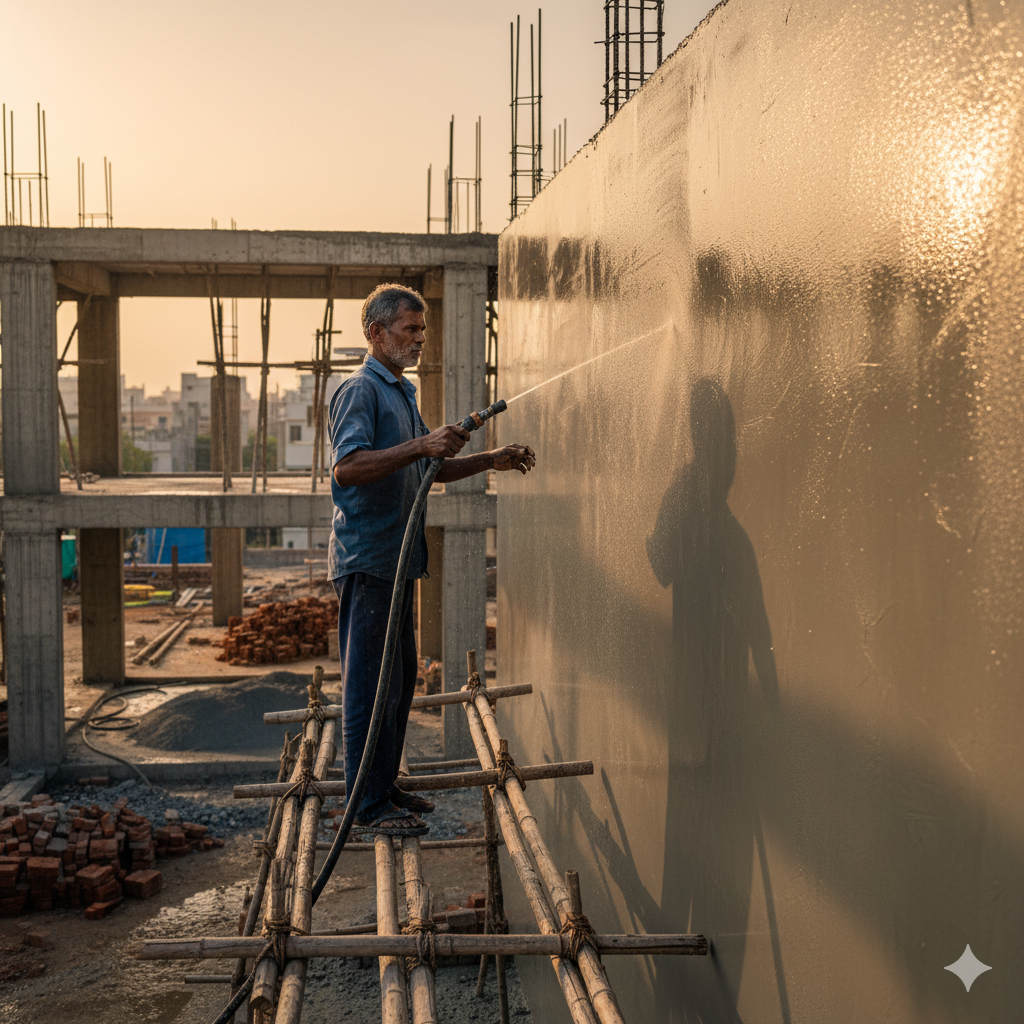
Direct Spray on the surface
Best practices to ensure proper curing of Cement Concrete:
| Category | Method | Description | Primary Goal | Best Suited For |
| I. Maintaining Moisture (Water Curing) | Ponding/Immersion | Creating a shallow pool of water on the surface and keeping it submerged. | Uniformly maintains moisture and temperature. | Flat surfaces (slabs, pavements). |
| Spraying or Fogging | Continuously or frequently misting the surface with water. | Stops rapid surface evaporation and cools the surface. | Vertical and flat surfaces, especially in hot, dry climates. | |
| Wet Coverings | Covering the concrete with materials like burlap or hessian that are kept continuously saturated with water. | Maintains a wet layer directly in contact with the concrete. | Columns, beams, and small areas. | |
| II. Preventing Moisture Loss (Barrier Curing) | Curing Compounds | Spraying an acrylic or wax-based liquid membrane onto the finished surface. | Traps the internal moisture by forming an impermeable seal. | Large areas where water curing is impractical. |
| Plastic Sheets/Impervious Paper | Covering the concrete with polyethylene sheets, with edges tightly sealed. | Physical barrier to stop water vapor from escaping. | Slabs and simple geometric shapes. | |
| Forms (Formwork) | Leaving the timber or steel formwork in place for the full curing period. | The formwork acts as an excellent vapor barrier. | Vertical surfaces (walls, columns, sides of beams). | |
| III. Controlling Temperature | Shading/Fogging | Providing physical shade and evaporative cooling. | Reduces the heat of hydration differential to prevent thermal cracks (Hot Weather). | All surfaces exposed to direct sunlight. |
| Insulating Blankets | Covering the concrete with specialized insulating material. | Retains heat of hydration and protects from freezing (Cold Weather). | All surfaces in cold temperatures. |