
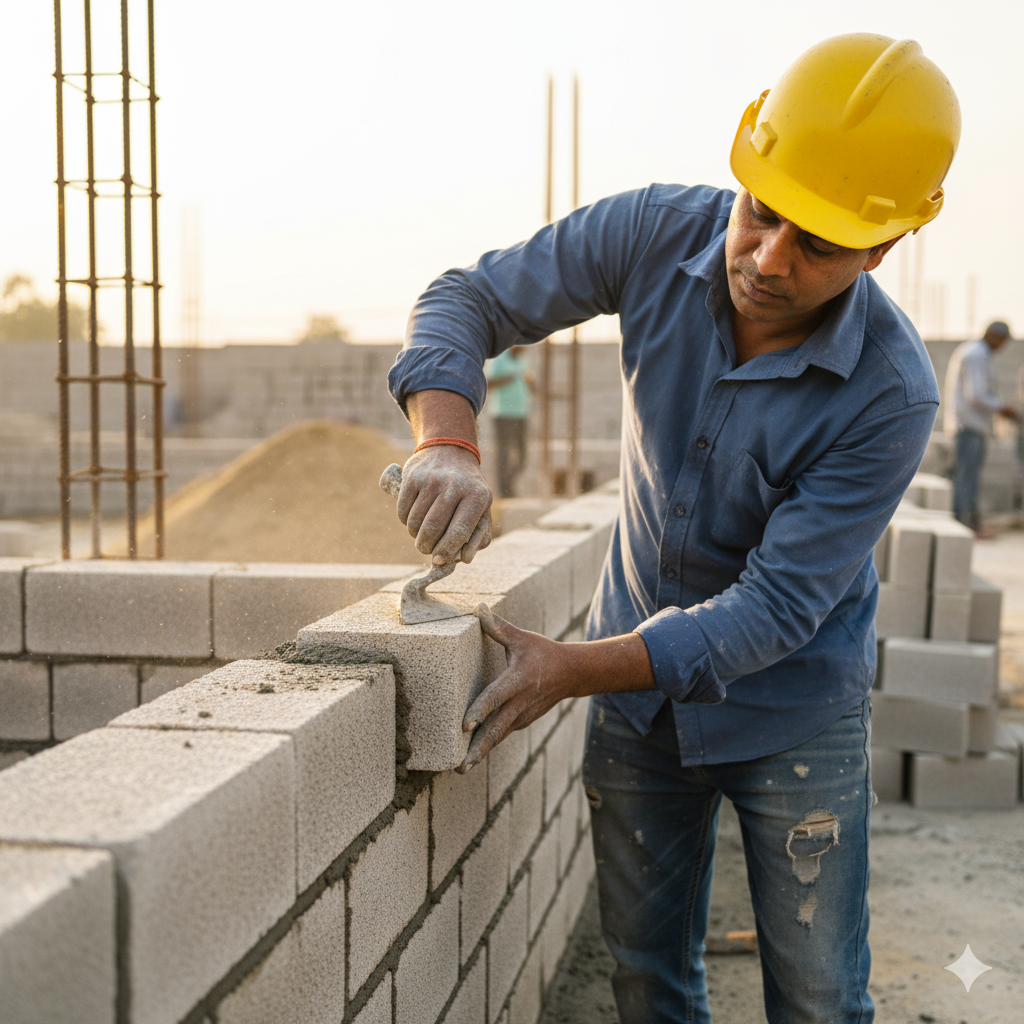
Are you building your dream home or property, and finding yourself confused about one of the most fundamental building materials: bricks? If you’re struggling to decide whether to choose Traditional Red Clay Bricks or modern Fly Ash Bricks, you’re not alone. Don’t worry—we are here to help you select the right material for your project, backed by scientific facts and rationale. Bricks are crucial in providing the ultimate strength and durability to any structure, making it essential to select a high-quality product.
Bricks are used primarily in exterior walls or partition walls, and the properties needed for these two kinds of walls are slightly different. Exterior walls are load-bearing, requiring high compressive strength, durability against weather, and good insulation. Conversely, interior partition walls primarily require uniformity, sound dampening, and reduced weight to lessen the overall structural load.
Let’s discuss the key properties that determine a brick’s strength, durability, and overall fitness for classification as a superior building material.
| Property | Fly Ash Bricks (Modern/Green Brick) | Traditional Red Clay Bricks (Conventional) |
| Primary Composition | Fly ash (thermal power waste), cement, sand, and water. | Natural clay, shale, and often sand (fired in a kiln). |
| Strength (Compressive) | Higher. Often 75-100 (kg/cm)^2 or more. Achieves consistent strength due to high-pressure molding. | Lower to Moderate. Generally 35-75 ( kg/cm)^2. Strength varies depending on the quality of the clay and the firing process. |
| Weight (Density) | Lighter. Lower density reduces the dead load on the structure’s foundation. | Heavier. Higher density increases the structural dead load. |
| Water Absorption | Low (typically 6% – 12%). Does not require soaking before use, saving time and water. | High (typically 15% – 25%). Requires soaking for 12-24 hours before laying to prevent drying out mortar. |
| Thermal Insulation | Better. Density and composition often result in better insulation, reducing heat transfer and potentially saving energy costs. | Lower. Acts more as a thermal mass (absorbing and releasing heat slowly) than an insulator. |
| Efflorescence | Low Risk. Salts are minimal, and low porosity prevents water movement that causes white salt deposits. | High Risk. Higher salt content and greater porosity often lead to efflorescence (white patches) on the surface. |
| Uniformity & Finish | Excellent. Highly uniform size and smooth surface. Reduces mortar consumption and plaster thickness. | Poor. Irregular size, shape, and surface texture due to firing. Requires thicker plastering. |
| Environmental Impact | Lower Footprint. Utilizes industrial waste (fly ash) and is non-fired (air or steam cured), saving fuel and virgin topsoil. | Higher Footprint. Consumes fertile topsoil and the firing process is energy-intensive, releasing pollutants. |
| Cost | Generally competitive or slightly lower (depending on local availability of fly ash). Often saves money on mortar and plastering. | Cost varies significantly based on local clay quality and transportation distance. |
Apart from these factors, the Environment is another crucial consideration when selecting bricks. Fly ash bricks are inherently more sustainable as they utilize fly ash, a waste product primarily generated by thermal power plants. Traditional Red Clay Bricks, on the other hand, consume the top layer of clay from fertile farmlands and require burning for several days. This firing process causes significant environmental pollution.
Fly ash bricks are superior in strength as well as other desired properties, offering a sustainable and effective alternative to traditional red clay bricks. Their uniform shape and size also increase the speed of execution.”