
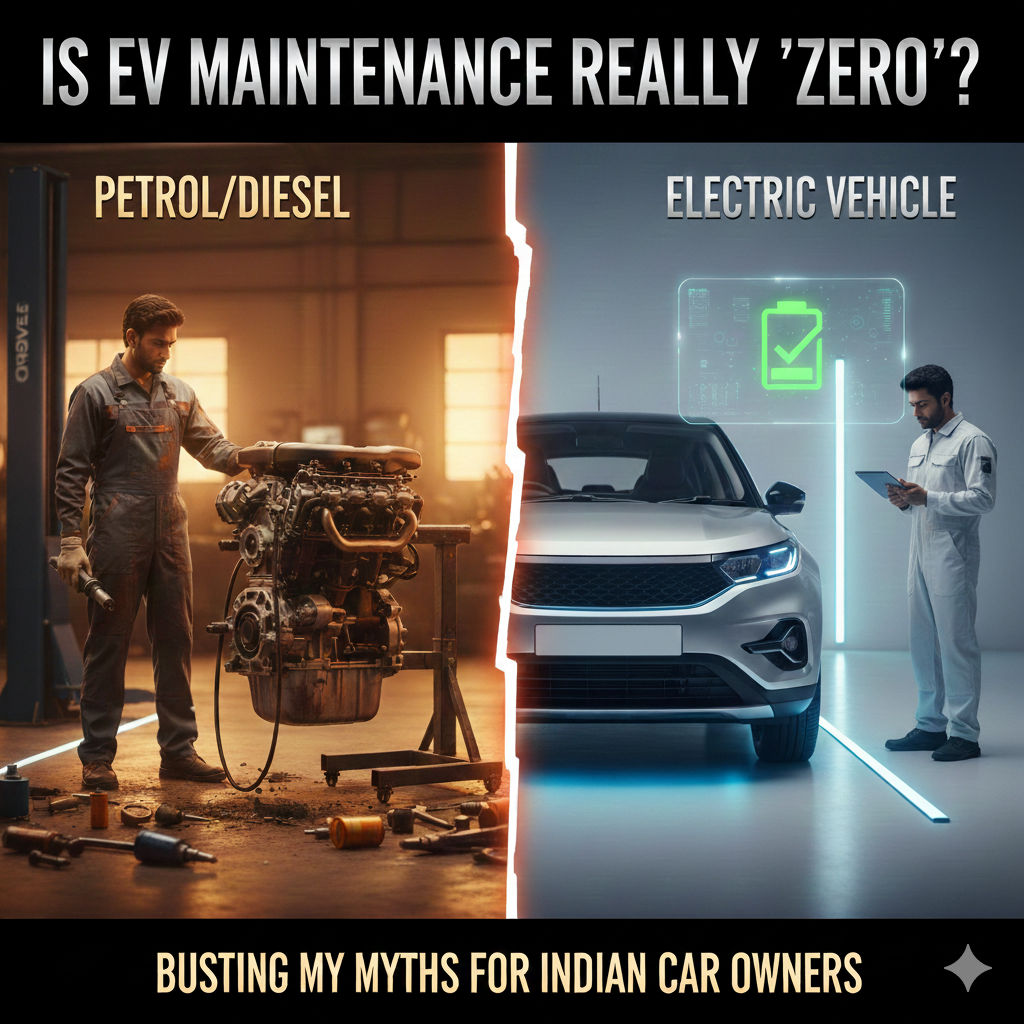
If you’ve recently walked into a car showroom in India, you’ve likely heard the pitch: “Buy an Electric Vehicle (EV) and forget about EV Maintenance service bills!” While it’s true that EVs like the Tata Nexon EV or MG ZS EV have far fewer moving parts than traditional petrol or diesel cars, the idea that maintenance is literally zero is one of the biggest misconceptions in the market today.
Today, we are diving deep into the data to bust the top 5 myths about EV maintenance specifically for the Indian context.
Myth 1: EVs don’t need any regular servicing.
The Reality: While you can say goodbye to oil changes, spark plugs, and air filters, an EV still requires a periodic health check.
- What stays: You still need to check brake fluid, wiper fluid, and the cabin AC filter.
- The New Checklist: Modern EVs require a Battery Health Diagnostic scan and a check of the High-Voltage (HV) cooling system to ensure the battery stays at its optimal temperature in the harsh Indian summer.
Myth 2: EV batteries need replacement every 3–5 years.
The Reality: This is perhaps the most persistent fear among Indian buyers.
- The Data: Most manufacturers in India (Tata, MG, Hyundai) provide an 8-year or 1,60,000 km warranty on the battery.
- The Truth: Real-world data shows that modern Lithium-ion batteries in EVs are designed to last 10–12 years before their capacity drops significantly. Even then, the car remains drivable; it just offers slightly less range.
Myth 3: Brake maintenance is expensive due to high weight.
The Reality: Actually, the opposite is true!
- Regenerative Braking: Most EVs use “Regen,” where the motor reverses to slow the car down and recharge the battery. This means you rarely use the physical brake pads.
- The Result: EV brake pads typically last 2 to 3 times longer than those on a petrol car. In many cases, you might not need a brake pad change for 60,000+ km.
Myth 4: Tyres on EVs wear out at the same rate as petrol cars.
The Reality: This is a “hidden” cost that many owners miss.
- Instant Torque: EVs provide 100% of their power the moment you touch the pedal. This “instant pull,” combined with the extra weight of the battery, puts more stress on the rubber.
- The Impact: Expect to replace EV tyres roughly 20% sooner than on a traditional car. It is crucial to use EV-specific tyres that are designed to handle this extra weight and torque.
Myth 5: Service centers will charge you “Tech Premiums.”
The Reality: Because there are fewer mechanical parts to fix, service centers actually have less to bill you for.
- The Comparison: A standard 10,000 km service for a petrol SUV in India costs between ₹8,000 – ₹12,000.
- The EV Bill: For an EV, the same service typically costs ₹2,000 – ₹4,000, mainly covering labor, software updates, and basic top-ups.
🏁 The “Complete” 10-Year Financial Comparison
To see the real truth, let’s look at the Total Spend after 10 years and 1.5 Lakh km (including one major “life-extending” repair).
| 10-Year Cost Category | Petrol/Diesel SUV (1.5L km) | Electric SUV (1.5L km) |
| Fuel / Charging | ₹12,00,000 (at ₹100/L) | ₹1,80,000 (at ₹8/unit) |
| Regular Service Bills | ₹1,50,000 | ₹40,000 |
| Major Component Repair | ₹2.5 Lakh (Engine Overhaul) | ₹6.0 Lakh (Battery Swap) |
| Total 10-Year Spend | ₹16,00,000 | ₹8,20,000 |
The Final Verdict
Is EV maintenance zero? No. But it is significantly lower—often by 60% to 70%—compared to traditional internal combustion engines. While you might pay a bit more for tyres and insurance, the massive savings on “oil-and-filter” services and fuel make it a winner for high-mileage drivers. Even if you pay ₹6 Lakh for a brand-new battery after 10 years, you have already saved over ₹10 Lakh in fuel and service costs compared to a petrol car. In simple terms: The EV pays for its own new battery twice over!
Pro-Tips
Check for “Battery Recycling” Credits: In 2025, manufacturers offer buy-back value for your old battery (which can be used for home solar storage), reducing your replacement cost by ₹50,000 – ₹1,00,000.
Battery Prices are Dropping: Industry experts predict battery costs will drop by another 30-40% by 2030. The battery you replace in 8 years will be much cheaper than it is today.