
Are you currently constructing your dream home or a new commercial space? If so, you’ve likely reached the stage where you need to decide on a bonding material—and found yourself at a crossroads: Should you stick with traditional cement-sand mortar, or move to modern tile adhesive?
It’s a doubt almost every property owner faces today. You probably want to understand exactly why professionals are increasingly preferring tile adhesive over the age-old cement mix, and what the real cost impact is on your budget.
However, the decision isn’t just about price—it’s about the survival of your flooring. Have you ever noticed brand-new tiles developing hollow sounds when walked upon, or worse, hairline cracks appearing just months after installation? These are the classic symptoms of improper cohesion. Traditional cement-sand mortar often shrinks as it dries, creating invisible air pockets behind the tile. Without 100% support, even a minor impact can cause an expensive vitrified tile to shatter or “pop” out of place.
Over the years, our decor choices have also evolved. High-end finishes like Stone Cladding are now popular options to improve ambience, but their heavy weight and vertical application make the superior ‘chemical grip’ of tile adhesive mandatory. In this guide, we resolve these doubts by breaking down why modern materials demand modern bonding solutions to prevent costly repairs down the line.
What is the Difference between Tile adhesive & Cement Sand Mortar Preparation:
Traditional Mortar: A site-mix of Ordinary Portland Cement (OPC), sand, and water. It relies on a “mechanical grip”—the cement seeped into the pores of the tile.
Tile Adhesive: A factory-made, polymer-modified blend. It uses “chemical bonding” to literally glue the tile to the floor, making it far stronger and more flexible.
Comparison Table: Tile Adhesive Vs Cement Sand Mortar
| Feature | Traditional Cement-Sand Mortar | Modern Tile Adhesive |
| Preparation | Time-consuming (Mixing sand, cement, water) | Instant (Just add water) |
| Bonding Strength | Moderate (Prone to hollow spaces) | High (Superior polymer-bond) |
| Application Thickness | 12mm – 20mm (Heavy & Bulky) | 3mm – 6mm (Light & Thin) |
| Tile Type | Only for porous ceramic tiles | All types (Vitrified, Glass, Marble) |
| Wastage | High (Sand piles, spills) | Minimal (Pre-packed bags) |
| Speed | Slow (Needs curing time) | 3x Faster (Saves labor costs) |
Top 3 Reasons to Choose Tile Adhesive (The Value)
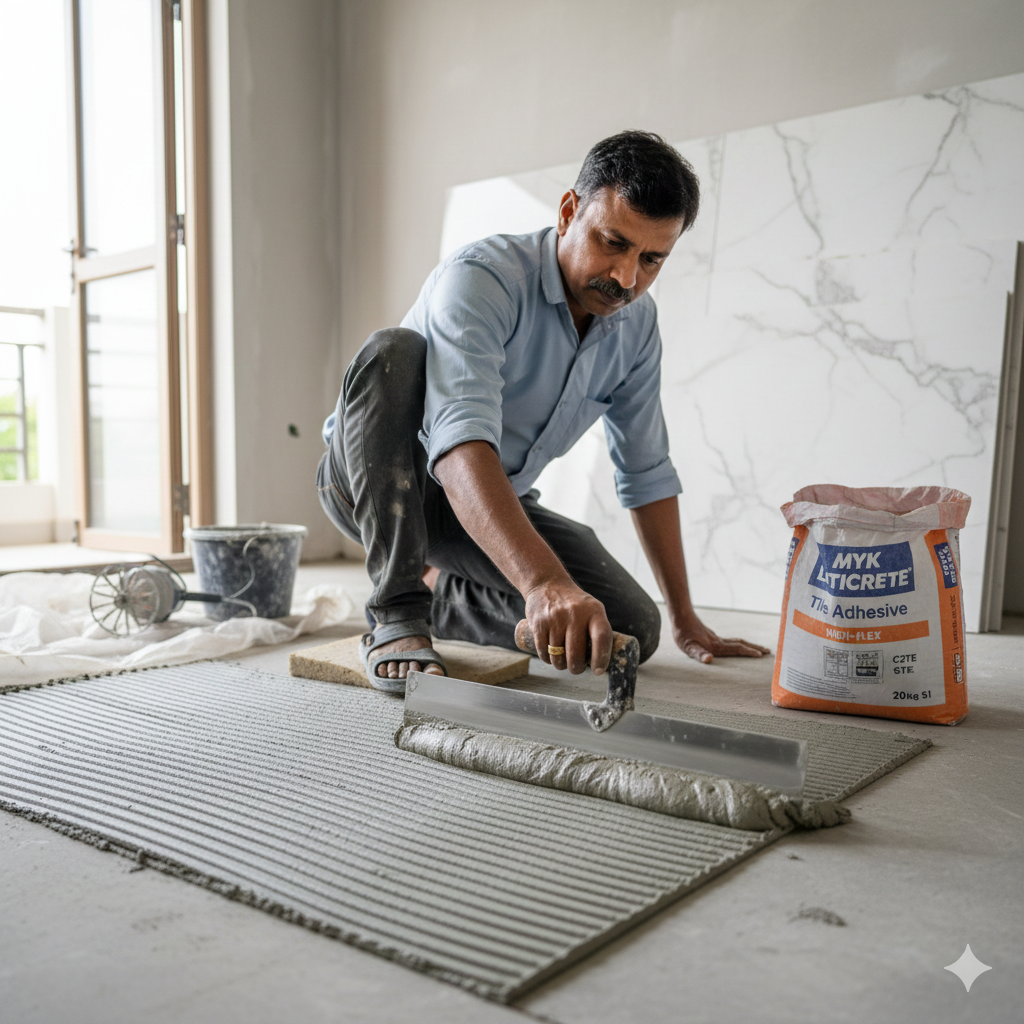
- No More “Hollow” Sounds: Because adhesive is applied with a notched trowel, it spreads 100% evenly. No air pockets means no cracks and no “tuk-tuk” sound when you walk.
- Perfect for Vitrified Tiles: Modern vitrified tiles are non-porous. Traditional cement has nothing to “grip” onto, leading to tiles popping up. Adhesive is chemically designed to stick to these smooth surfaces.
- Waterproof Protection: Most high-grade adhesives are water-resistant, making them mandatory for bathrooms, balconies, and swimming pools where traditional cement often fails and leads to seepage.
💰 Costing Difference Analysis (Per 100 Sq. Ft.)
In the Indian market, while the material cost of adhesive is higher, the “System Cost” tells a different story. Below is an approximate comparison for standard floor tiling:
| Cost Factor | Traditional Cement-Sand Mortar | Modern Tile Adhesive |
| Material Consumption | High (12mm to 20mm thick bed) | Low (3mm to 6mm thin bed) |
| Material Cost | ₹1,500 – ₹2,200 | ₹3,500 – ₹5,000 (Varies by Grade) |
| Labor Cost | Higher (Slow mixing & application) | Lower (3x faster installation) |
| Water Curing | Required for 7 days (Extra labor) | Not required |
| Wastage | 10-15% (Sand/Cement spills) | < 2% (Pre-packed precision) |
| Total System Cost | Lower Upfront | ~20-30% Higher Upfront |
The “Value” Insight: While you might spend ₹1,500–₹2,000 extra per 100 sq. ft. on adhesive, you are essentially buying “Insurance” against tile cracking. Replacing just TWO cracked large-format vitrified tiles in the future will cost you more than the entire savings you made by using cement today.
🌟 Underlying Benefits: Why the Extra Cost is Worth It
Beyond just “sticking tiles,” adhesive provides three critical technical benefits that traditional cement simply cannot match:
1. Superior “Chemical” Grip vs. “Mechanical” Grip
Traditional cement relies on “Mechanical Grip”—it has to seep into the pores of a tile to hold it. Modern Vitrified Tiles and Stones are almost non-porous. Cement has nothing to grab onto! Adhesive uses polymers to create a Chemical Bond, literally “fusing” the tile to the floor.
2. Thermal Flexibility (India’s Heat Factor)
India experiences extreme temperature swings. Traditional cement is rigid; when your floor expands in the summer heat, the cement doesn’t move, leading to buckling or “popping” tiles. Adhesive is flexible (deformable), meaning it acts like a shock absorber, expanding and contracting with the building.
3. Maximum Floor Space (Thin-Set Advantage)
Because adhesive is applied in a very thin layer (3-6mm), it doesn’t raise the floor height as much as a 20mm cement bed. This is crucial for:
- Renovations: You can often do “Tile-on-Tile” work without removing the old floor or shaving off the bottom of your doors.
- Weight Reduction: It reduces the “dead load” on your building structure, which is vital for high-rise apartments and commercial spaces.
4. Zero “Hollow” Spots
Using a notched trowel ensures 100% coverage. Traditional “dab” or “blob” setting with cement leaves air pockets. These air pockets are where water collects in bathrooms (leading to seepage) and where tiles crack when a heavy object is dropped.
🏆 Popular Brands and Price Range in India (2025)
The Indian market is home to several global and domestic giants that offer specialized adhesives for different surfaces. The price of tile adhesive is usually calculated per 20 kg bag and varies based on the “Type” or “Class” of adhesive (e.g., Type 1 for floors, Type 2 for walls/vitrified tiles).
Leading Brands in the Market:
- Roff (Pidilite): Perhaps the most famous name in India, known for their T01 (basic) and Vitrofix (premium) series.
- MYK Laticrete: The gold standard for professional contractors, offering high-performance solutions like the 305 and 325 series for heavy stones and marbles.
- Saint-Gobain Weber: A global leader known for their Weberset series, which is highly popular for “tile-on-tile” and exterior applications.
- Asian Paints SmartCare: A trusted household name offering reliable options like UltraGrip and Fabseal for standard residential projects.
- Dr. Fixit & UltraTech: Widely available brands that provide excellent budget-friendly to mid-range options for general flooring needs.
Typical Price Range per 20kg Bag:
| Adhesive Type | Usage | Approx. Price (INR) |
| Standard (Type 1) | Basic Ceramic tiles on floors. | ₹250 – ₹450 |
| Premium (Type 2) | Vitrified tiles and wall applications. | ₹500 – ₹850 |
| High-Flex (Type 3/4) | Exterior cladding, stones, and glass mosaic. | ₹900 – ₹1,800 |
🏁 The Final Takeaway: Which One Should You Choose?
“Choosing between tile adhesive and traditional cement isn’t just a matter of price—it’s a matter of longevity and safety.
While traditional cement-sand mortar has served us for decades, it was designed for a different era of construction. Today’s modern materials, like large-format vitrified tiles and heavy stone cladding, are essentially non-porous. They require a chemical bond to stay in place, something a basic cement mix simply cannot provide over the long term.
The Verdict is Clear:
- Choose Traditional Cement ONLY if you are on a very tight budget and are installing small, porous ceramic tiles in a dry, low-traffic area.
- Choose Tile Adhesive for everything else—especially for bathrooms, kitchens, exterior walls, and any tile larger than 2×2 feet.
The Bottom Line: You are spending lakhs on your dream home’s interiors. Don’t let a small saving on bonding material lead to hollow sounds, water seepage, or the heartbreak of seeing your expensive tiles crack. Tile adhesive is the insurance your floor deserves.“